

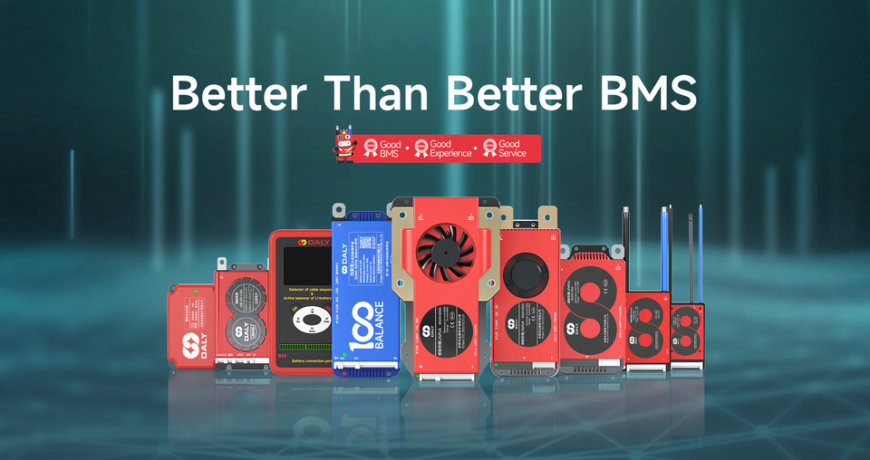
A battery pack is only as safe as the board protecting it. Whether you are building a 12V LiFePO4 battery for a solar backup, a 48V pack for an inverter, or a 72V pack for an electric bike or rickshaw, the Battery Management System (BMS) decides how long your cells live and whether they stay safe in Pakistan’s summer heat.
This guide explains, in plain language, how to choose the right BMS: the cell count, current rating, battery chemistry and features that actually matter, with worked examples.
What does a BMS do?
A BMS sits between your cells and the load or charger. It continuously watches every cell and disconnects the pack when something goes wrong:
- Over-charge protection: stops charging when any cell reaches its maximum voltage.
- Over-discharge protection: cuts the load before any cell is drained low enough to be damaged.
- Over-current and short-circuit protection: disconnects instantly if the load draws too much current.
- Cell balancing: slowly evens out the voltages of the cells so the whole pack stays usable.
- Temperature protection (on boards with a temperature sensor): stops charging or discharging when the pack is too hot or too cold.
Without a BMS, a single weak cell can be over-charged or drained to zero, which shortens the pack’s life and, with lithium cells, can be a fire risk.
Step 1: Match the battery chemistry (LiFePO4 or Li-ion)
This is the most common mistake. A BMS is built for one chemistry because the safe voltage limits are different:
| Chemistry | Nominal voltage per cell | Full-charge voltage per cell | Typical use |
|---|---|---|---|
| LiFePO4 (LFP) | 3.2V | about 3.65V | Solar storage, inverters, UPS, rickshaws |
| Li-ion (NMC / 18650 / 21700) | 3.6–3.7V | about 4.2V | E-bikes, power tools, portable packs |
A Li-ion BMS on LiFePO4 cells will let them over-charge, and a LiFePO4 BMS on Li-ion cells will never charge them fully. Always buy the BMS labelled for your chemistry, for example a LiFePO4 (LFP) BMS for LiFePO4 cells.
Step 2: Choose the series count (“S”)
The “S” number is how many cells (or parallel cell groups) are connected in series. It sets the pack voltage, and the BMS must have exactly the same S rating.
| System voltage | LiFePO4 cells in series | Li-ion cells in series |
|---|---|---|
| 12V | 4S (12.8V) | 3S (11.1V) |
| 24V | 8S (25.6V) | 7S (25.9V) |
| 36V | 12S (38.4V) | 10S (37V) |
| 48V | 16S (51.2V) | 13S (48.1V) |
| 60V | 20S (64V) | 16S (59.2V) |
| 72V | 24S (76.8V) | 20S (74V) |
Example: a 24V LiFePO4 pack needs an 8S 24V LiFePO4 BMS, and a 72V LiFePO4 rickshaw pack needs a 24S 72V BMS.
Step 3: Choose the current rating (A)
The current rating is the continuous current the BMS can carry. Work it out from your largest load, then add a safety margin of about 25%.
Formula: Current (A) = Load power (W) ÷ Battery voltage (V) ÷ Inverter efficiency (about 0.9)
Example 1: 1,000W inverter on a 12V LiFePO4 pack
1,000 ÷ 12.8 ÷ 0.9 ≈ 87A, plus a 25% margin ≈ 108A. Choose a 4S 12V BMS rated 100A or more, preferably higher, because inverters draw surge current when motors or compressors start.
Example 2: E-bike with a 1,500W motor on a 60V pack
1,500 ÷ 64 ≈ 23A, plus margin ≈ 30A. A 20S 60V 30A BMS is a good fit; if you climb hills or carry heavy loads, go one size higher.
An under-rated BMS will keep cutting out under load and runs hot. An over-rated one costs a little more but runs cooler and lasts longer, which matters in a 45°C summer.
Step 4: Common port or separate port?
- Common port: the charger and the load use the same two wires. Simple wiring, and the most common choice for solar, inverter and UPS batteries.
- Separate port: the charger connects to its own wire, usually with a lower current limit. Often used in e-bikes and scooters, where the charger and motor controller are wired separately.
Check which one your project needs before buying, and follow the wiring diagram that comes with the board.
Step 5: Features worth paying for
- Temperature sensor (NTC): strongly recommended in Pakistan. Batteries kept in a hot room or under a rickshaw seat can overheat in summer.
- Smart BMS (Bluetooth / UART / CAN): lets you see every cell’s voltage, current and temperature on your phone, and communicate with some inverters. Very useful for 48V solar storage.
- Active balancer: standard boards balance slowly with a small current. For large packs (100Ah and above) or older cells, an active balancer keeps the cells much closer together.
Installation tips that prevent most failures
- Use cells of the same type, capacity and age, and bring them to the same voltage before building the pack (top-balancing).
- Connect the balance (sense) wires in the exact order shown on the BMS diagram, B- first.
- Before plugging the balance connector into the BMS, check the voltage of each wire with a multimeter. Each step should rise by one cell voltage.
- Use cables thick enough for the current, and crimp lugs properly. Loose connections cause heat.
- Mount the BMS where air can flow over it; never wrap it tightly inside the pack.
Frequently asked questions
Can I use a 4S BMS for a 12V lead-acid replacement?
Yes. A 4S LiFePO4 pack (12.8V) with a 4S LiFePO4 BMS is the standard drop-in replacement for a 12V lead-acid battery in UPS and solar systems. Make sure your charger has a lithium or LiFePO4 setting.
What happens if I choose a BMS with a lower current rating?
The BMS will disconnect the battery whenever the load draws more than its limit, so your inverter or motor will keep shutting off. Repeated overloading also heats the board and shortens its life.
Do I need a BMS if my cells are already balanced?
Yes. Cells drift apart with use, and the BMS also protects against over-current, short circuits and over-discharge, not only imbalance.
Which BMS brand is reliable?
DALY is one of the most widely used BMS brands for LiFePO4 and Li-ion packs, with models from 4S to 24S and from 20A to several hundred amps. Browse the full range in our BMS category.
Need help choosing?
Tell us your battery chemistry, number of cells and the largest load you want to run, and our team will recommend the right BMS. You can also browse batteries and chargers and EV parts for the rest of your build. We deliver across Pakistan.
