

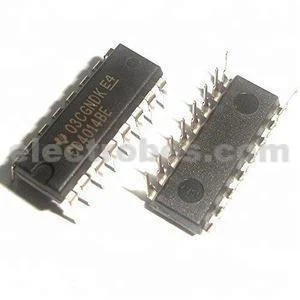
CD4014 8-Bit Static Shift Register IC
- 8-bit static shift register (CMOS)
- Parallel-in or serial-in, serial out
- Wide CD4000B supply range
- 16-pin DIP package
- Ideal for reading 8 buttons with 3 pins
- Fully static operation
In stock
₨ 70
In stock
The CD4014 is an 8-bit static shift register in CMOS. It can load eight inputs at once (parallel in) and then shift them out one bit at a time (serial out), so it lets a microcontroller read eight buttons or switches using only three pins.
Key Features
- 8-stage static shift register
- Parallel or serial input, serial output
- Outputs available from stages 6, 7 and 8
- Wide supply range (CD4000B series)
- 16-pin DIP package
- Fully static operation
How It Works
When the parallel/serial control pin is HIGH, a clock pulse loads all eight parallel inputs into the register. When it is LOW, each clock pulse shifts the data one stage along, and the bits appear one by one at the Q8 output. An Arduino can read eight buttons by pulsing the load, then clocking and reading Q8 eight times. To expand outputs instead of inputs, use the 74HC595 shift register.
Power and Wiring Tips
CD4000-series CMOS chips run from a wide supply range, typically 3 V to 18 V, so the same chip works from a 5 V breadboard power module, a 9 V battery with a 9V battery snap or a 12 V rail. Tie every unused input to VDD or VSS, because floating CMOS inputs can make the chip draw extra current or behave unpredictably. Place a 100nF (104) ceramic capacitor between the supply pins, as close to the chip as possible, to stop switching noise causing false triggering.
Building and Testing
The 16-pin DIP package plugs straight into a full-size breadboard for testing. On a permanent board, solder a 16-pin DIP IC socket first so the chip can be replaced without desoldering. You can drive inputs with tactile push buttons and 10K pull-down resistors, and watch outputs with a 5mm red LED and a 220 ohm resistor. Handle CMOS chips by the body and avoid touching the pins, since static can damage them. Find more logic chips in logic gate ICs and general ICs.
Technical Specifications
| Part number | CD4014 |
|---|---|
| Function | 8-bit static shift register, parallel/serial in, serial out |
| Logic family | CMOS CD4000B |
| Package | 16-pin DIP |
| Power pins | 16 = VDD, 8 = VSS |
| Power dissipation | 500 mW (package, as listed) |
| Operating temperature | -55 °C to +125 °C (as listed) |
Applications
- Reading many buttons with few microcontroller pins
- Keypad and switch scanning
- Parallel-to-serial data conversion
- Digital electronics coursework
Notes for Buyers in Pakistan
Electronics students in Pakistan use this chip in digital logic labs and final-year projects. Keep spare chips in anti-static foam or the tube they come in, and store them dry in humid weather to prevent the pins from oxidising.
Frequently Asked Questions
How is CD4014 different from 74HC595?
The CD4014 is parallel-in, serial-out (for inputs). The 74HC595 is serial-in, parallel-out (for outputs).
Can I drive this CMOS chip from an Arduino?
Yes. With the chip running from 5 V, an Arduino Uno’s 5 V outputs drive its inputs directly, and its outputs can be read by Arduino inputs. If you run the chip at a higher voltage, add level shifting.
Based on 0 reviews
Be the first to review “CD4014 8-Bit Static Shift Register IC”
You must be logged in to post a review.
Related products
-
Discrete Electronic Components, Potentiometer & Knobs, Resistors
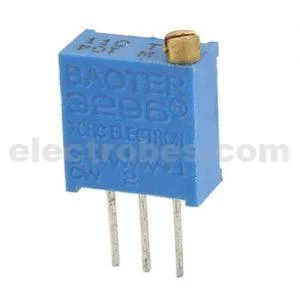
100K Ohm 104 Multi turn Trimpot Potentiometer / Variable Resistor
 Discrete Electronic Components, Potentiometer & Knobs, Resistors
100K Ohm 104 Multi turn Trimpot Potentiometer / Variable Resistor
- Resistance: 100 kΩ (code 104)
- Multi-turn adjustment for fine, precise setting
- 3296-style square body with top adjusting screw
- 3 pins: two track ends and the wiper
- PCB through-hole mounting, 2.54 mm-friendly
SKU: 076 -
Discrete Electronic Components, Resistors, Through Hole Resistors
47 Ohm Axial 1/4W Resistor
- Resistance: 47 Ω
- Power rating: 1/4 W
- Package: axial through-hole
- Tolerance: shown by the colour band
- 4-band code: yellow, violet, black
- Max current at full rating: about 72.9 mA
- For breadboard, veroboard and PCB use
SKU: 004 -
Discrete Electronic Components, Resistors, Through Hole Resistors
150K Ohm Axial 1/4W Resistor
- Resistance: 150 kΩ
- Power rating: 1/4 W
- Package: axial through-hole
- Tolerance: shown by the colour band
- 4-band code: brown, green, yellow
- Max current at full rating: about 1.3 mA
- For breadboard, veroboard and PCB use
SKU: 067 -
Discrete Electronic Components, Resistors, Through Hole Resistors
1M Ohm Axial 1/4W Resistor
- Resistance: 1 MΩ
- Power rating: 1/4 W
- Package: axial through-hole
- Tolerance: shown by the colour band
- 4-band code: brown, black, green
- Max current at full rating: about 0.5 mA
- For breadboard, veroboard and PCB use
SKU: 024 -
Discrete Electronic Components, Resistors, Through Hole Resistors
68 Ohm Axial 1/4W Resistor
- Resistance: 68 Ω
- Power rating: 1/4 W
- Package: axial through-hole
- Tolerance: shown by the colour band
- 4-band code: blue, grey, black
- Max current at full rating: about 60.6 mA
- For breadboard, veroboard and PCB use
SKU: 045


There are no reviews yet.